By Ed Sutton, MD
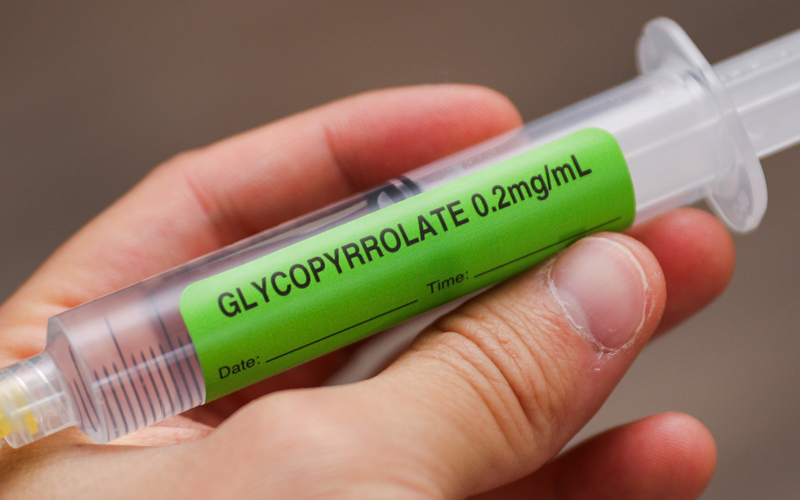
During the last several decades of the 20th century, clinicians frequently used Glycopyrrolate (Robinul) in a mixture as an intramuscular injection before surgery. They added it as a premedication for its antisialagogue effect and administered it before the patient’s arrival in the operating room to ensure its drying effect took full effect. Does modern anesthesia practice justify routinely using glycopyrrolate as a premed, or has it become an outdated practice that providers should abandon to achieve “best practices”? To make that decision, each anesthesia provider must weigh the benefits against the risks involved in the procedure.
Glycopyrrolate is a synthetic anticholinergic antagonist at the muscarinic receptor; it does not affect nicotinic receptors (which are competitively blocked by the tubocurarine/aminosteroid class of drugs and activated by succinylcholine). Glycopyrrolate has broad effects across the parasympathetic nervous system, often creating unwanted effects other than the desired antisialagogue effect. These effects are also of long duration, lasting 6–8 hours.
The smooth muscle relaxation effects of the drug are significant in the endoscopy suite. The esophagus is the only muscle composed of both striated voluntary and smooth involuntary muscle fibers. The upper one-third of the organ is striated and subject to voluntary contraction, the middle third is a mixture of striated and smooth muscle, and the lower third is purely smooth muscle. The distal esophagus comprises the lower esophageal sphincter, which prevents reflux of gastric contents.
Glycopyrrolate directly decreases the tone of the lower esophageal sphincter, potentially worsening reflux of acid and gastric contents and increasing the risk of aspiration. Clinicians should contraindicate the drug in patients with GERD, particularly when deep sedation is administered with an unprotected airway—commonly encountered during GI procedures. Glycopyrrolate also relaxes smooth muscle in the small and large intestines, making expulsion of insufflated air more difficult.
The effects of glycopyrrolate on the eyes are also concerning. The drug decreases lacrimal gland function, resulting in dry eyes that are often not lubricated during deep sedation. It relaxes both the iris and ciliary body, which in patients with intraocular hypertension or undiagnosed glaucoma may precipitate acute angle-closure glaucoma (AACG), leading to severe eye pain, blurred vision, nausea, vomiting, and possible optic nerve damage.
Glycopyrrolate also affects smooth muscle throughout the urinary system and may cause acute urinary retention, particularly in males with prostatic hypertrophy. These effects can persist long after discharge, potentially necessitating emergency department visits for catheterization to relieve pain and retention.
Another common use of glycopyrrolate in anesthesia is to antagonize the cholinergic effects of acetylcholinesterase inhibitors such as neostigmine. Although their onset times are well matched, their durations of action are not. Neostigmine’s effects are significantly shorter, which may result in unopposed anticholinergic effects such as postoperative ileus and urinary retention. Sugammadex is now the preferred agent for reversal of aminosteroid neuromuscular blockers.
I believe the risks associated with using glycopyrrolate as a routine premedication far outweigh any benefits and that it should be abandoned as a relic of 20th-century anesthesia practice.